Ask your imaging archive the way you would ask a colleague

UC Davis Health · Computer Science and Radiology

Presented at the UC Davis Radiology Research Symposium 2026

Overview

Hospitals keep years of imaging studies, DICOM headers and radiology reports, yet answering a simple clinical question about them still means opening studies one by one or filing a ticket with IT. MedVision lets clinicians ask that question in plain English, show it an image, or both, and get back an answer they can check: counts and charts, matching studies with their reports, and visually similar cases, each shown with the evidence behind it.

See it in action

A live run: a plain-English question answered with a chart and its query, then an image search that returns similar past cases. Patient identifiers are hidden. Open the video.

Questions clinicians want to ask

PATIENT CARE

  • Was this lung nodule there 1, 3 or 5 years ago? Did it grow?
  • How many central lines has this patient had, left side and right side?
  • Was this liver lesion treated before? With what therapy?

TEACHING

  • This patient has an aneurysm. Show me other patients with one like it.
  • Find past cases that look like this one.

QUALITY

  • What radiation dose does each scanner deliver for the same study?
  • How many dialysis access interventions this year, and how many repeated within 90 days?

Why current tools fall short

  1. The search box decides what you can ask. The question has to be rewritten to fit fixed fields and search syntax.
  2. Only some details can be combined. Findings plus a few acquisition fields, not any DICOM header with any report finding.
  3. Analytics are limited. Counts and trends beyond the built-in reports need an analyst.
  4. You cannot search with an image. There is no way to show the archive a picture and ask for cases like it.
One unified solution

Ask
A question in plain English, an image, or both
MedVision
reads the reports, the DICOM headers and the images of your archive
Answer
Counts and charts, matching studies with their reports, visually similar cases

Every answer shows the evidence behind it.

Built to be trusted

Risk with AI modelsHow MedVision handles it
HallucinationAnswers come from database rows, not from the model's memory.
TraceabilityThe query, the returned rows and each step are shown with the answer.
Audit trailEvery question asked is logged.
Data privacyThe whole system runs locally; patient data never leaves the institution.

How it works

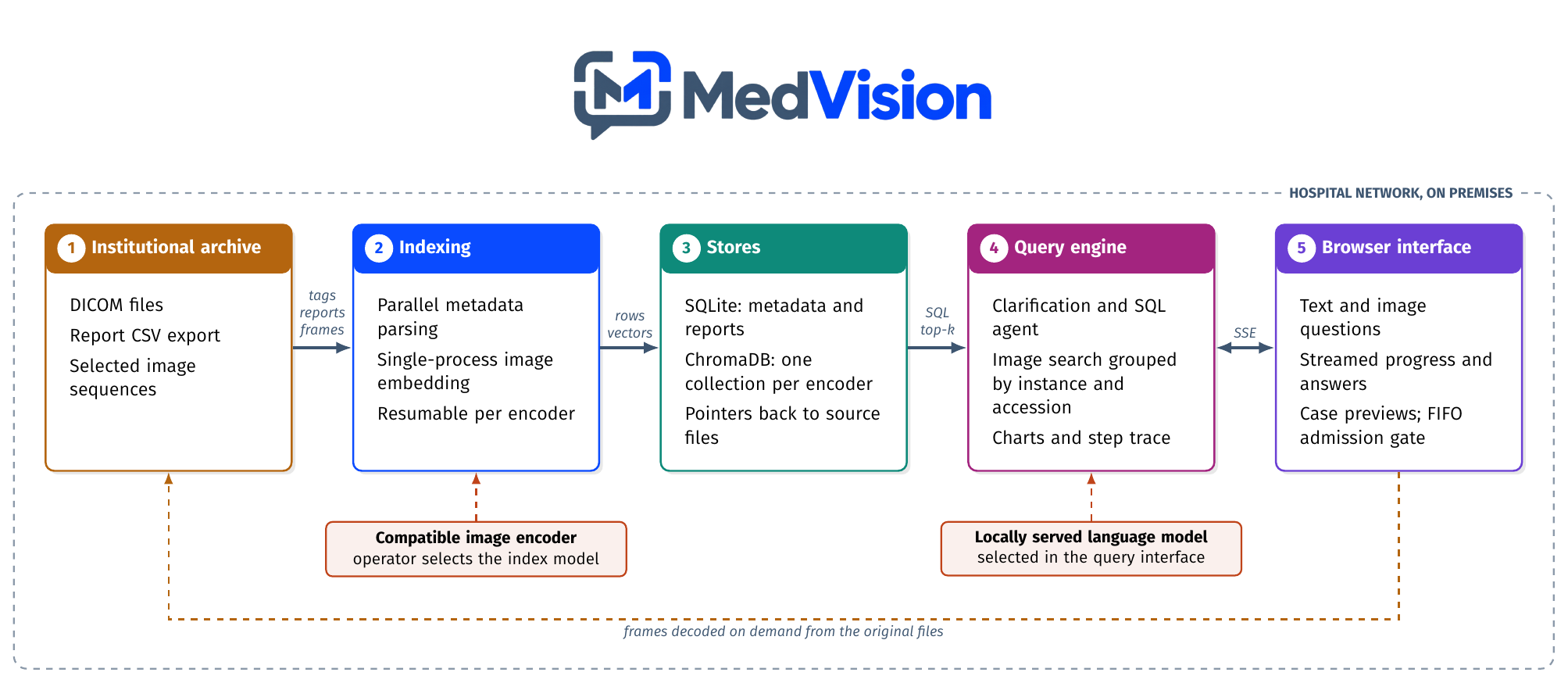
MedVision architecture: institutional archive, indexing, stores, query engine and browser interface, all on premises

PREPARED ONCE, FROM THE ARCHIVE

  • DICOM headers become a table of study and acquisition details.
  • Radiology reports are linked to each study by accession number.
  • Every image frame gets a numeric fingerprint for image search.

ANSWERING A QUESTION

  • A local language model turns the question into a read-only database query.
  • The database runs it. On an error, the assistant reads it and fixes the query.
  • The answer and chart are built from the returned rows.